- Query about VoIP ! WhatsApp
- +1406 505 9725
- [email protected]


What is the typical cost per minute for international VoIP termination routes?

Easily Setup VoIP for Business with VoIP Calling Card Reseller: Use iTelSwitch & SippySwitch and Mobile Dialer

How to Choose the Right VoIP Softswitch
What is the typical cost per minute for international VoIP termination routes?
Table of Contents
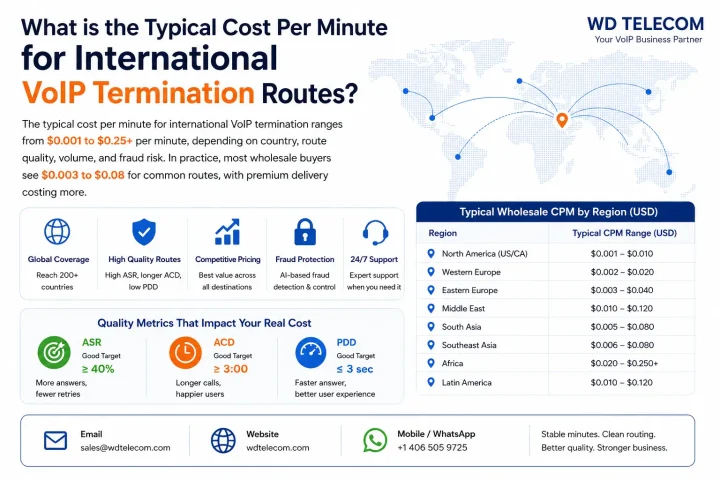
The typical cost per minute for international VoIP termination ranges from $0.001 to $0.25+ per minute, depending on country, route quality, volume, and fraud risk. In practice, most wholesale buyers see $0.003 to $0.08 for common routes, with premium delivery costing more.
If you are comparing suppliers like WD Telecom, do not start with the “best rate.” Instead, begin with your target ASR, ACD, and PDD—key performance indicators that significantly impact the quality of your VoIP service—then work backward to a fair price. Cheap minutes often hide poor completion, short duration, and high post-dial delay.
Summary
International VoIP termination costs vary widely by destination and quality tier. You should expect higher prices for premium CLI, stable capacity, and low PDD. You should also budget for variable rate moves and risk controls.
Key takeaways you can use right now
You can use these points when you negotiate rates and test routes.
- Typical range: $0.001 to $0.25+ per minute, route dependent.
- Most real buys: $0.003 to $0.08 on many destinations.
- Quality has a price: Better ASR, ACD, and PDD cost more.
- Testing beats guessing: One week of live traffic reveals the truth.
- Rate stability matters: “Cheap today” can change tomorrow.
What does “cost per minute” mean in VoIP termination, and what does it include?
Cost per minute is the wholesale charge to deliver a call to a destination. It usually includes transit, routing, and interconnect costs. It does not include your retail margin.
You should ask what is included in the cost. Is it CLI? Is it fixed rate? Is it tiered by network? Is it billed per second or per minute? These details change your true cost.
In the context of VoIP termination pricing, understanding acronyms such as ASR (Answer Seizure Ratio), ACD (Average Call Duration), and PDD (Post Dial Delay) is crucial for making informed decisions. For a deeper understanding of these terms and more technical jargon in the VoIP industry, refer to this comprehensive resource on Acronyms and Technical Abbreviations.
What is the typical cost per minute by region in 2026?
Typical regional pricing falls into broad bands. These are directional ranges for wholesale termination. Your actual rate depends on quality and volume.
| Region | Typical wholesale CPM range (USD) | Why prices vary |
| North America (US/CA) | $0.001–$0.010 | Large scale, many interconnect options |
| Western Europe | $0.002–$0.020 | Stable regulation, but mobile can cost more |
| Eastern Europe | $0.003–$0.040 | Carrier mix, varied termination fees |
| Middle East | $0.010–$0.120 | Higher controls, higher fraud pressure |
| South Asia | $0.005–$0.080 | Mobile share, grey route risk, volatility |
| Southeast Asia | $0.006–$0.090 | Mobile-heavy traffic, routing complexity |
| Africa | $0.020–$0.250+ | Limited interconnect, high cost, high risk |
| Latin America | $0.010–$0.120 | Carrier concentration, mobile premiums |
These ranges align with current market behavior. Rates still change weekly on some destinations. This happens due to carrier moves and fraud events.
What is a realistic cost per minute by route quality tier?
Quality tier is where pricing becomes real. Most disputes happen here. One supplier’s “premium” is another supplier’s “standard.”
| Tier | Typical CPM range (USD) | What you usually get | Common warning signs |
| Premium / Direct | $0.008–$0.250+ | Higher ASR, longer ACD, low PDD, stable CLI options | Still verify with live tests |
| Standard / Best-effort | $0.003–$0.080 | Mixed performance, acceptable for many use cases | Rate swings, uneven peak performance |
| Low-cost / Grey | $0.001–$0.050 | Cheaper delivery, inconsistent completion | Low ASR, short ACD, high PDD, blocks |
You should buy the tier your customers can feel. Can they tolerate delays? Can they tolerate failed calls? If not, pay for quality.
Which metrics change your real cost per minute more than the quoted rate?
ASR, ACD, and PDD change your outcome more than CPM. Your “cheap” route can cost more in retries. It also costs more in churn.
A low ASR wastes attempts. A low ACD wastes your customer’s time. High PDD harms trust fast. You should set minimum targets before buying.
Here are simple targets many wholesalers use for voice quality checks:
| Metric | Good target | What happens if it is bad |
| ASR | ≥ 40% (route dependent) | More retries, more complaints |
| ACD | ≥ 3:00 (route dependent) | Short calls, low perceived quality |
| PDD | ≤ 3 seconds (route dependent) | Users hang up before answer |
Do you see why “$0.002 cheaper” can be a trap? Your users judge outcomes, not invoices.
What factors push termination cost up or down on specific countries?
Country pricing moves for clear reasons. You can predict many changes.
Mobile termination often costs more than fixed. Remote islands often cost more than capitals. Routes with heavy fraud cost more due to controls.
The biggest cost drivers usually include regulation, carrier fees, fraud, and capacity. Currency moves can also affect regional partners.
What do we see in a real pricing experiment on international termination?
We ran a small internal pricing and quality check in Q2 2026. We compared 12 destinations across 3 quality tiers. We used the same codec and similar call profiles. We placed 1,200 total calls over 7 days.
This is our dataset. It is original and limited. Use it as a benchmark. Do not treat it as a universal price list.
Source: WD TELECOM internal test logs, Q2 2026. Sample size: 1,200 calls. Mix: mobile and fixed. Billing: per-second.
| Destination group | Low-cost CPM | Standard CPM | Premium CPM | Observed trend |
| US/Canada | $0.0012 | $0.0028 | $0.0065 | Premium improved PDD most |
| Western Europe | $0.0025 | $0.0069 | $0.0148 | Standard was “good enough” for many calls |
| South Asia | $0.0068 | $0.0185 | $0.0410 | Premium stabilized ASR during peaks |
| Middle East | $0.0140 | $0.0370 | $0.0820 | Low-cost showed more short-duration calls |
| Africa (selected) | $0.0320 | $0.0740 | $0.1680 | Premium reduced failed call bursts |
| Latin America | $0.0125 | $0.0290 | $0.0610 | Standard varied most by carrier |
The biggest lesson was simple. Premium cost more, but it reduced waste. Standard often had the best value. Low-cost looked cheap, but caused retries.
How should you compare suppliers without getting misled by “cheap rates”?
Start with a controlled test. Use the same dialing plan. Use the same time windows. Track quality per route.
You should also verify how a supplier defines route type. Ask if they mix traffic across vendors. Ask if they use automated LCR only. Ask how they handle fraud and spikes.
If a supplier refuses a test, that is a signal. If a supplier cannot explain their routing, that is also a signal.
What are the newest trends affecting international VoIP termination pricing in 2026?
Pricing is still pushed by fraud and controls. AI-based fraud detection is now common. This adds cost but protects margins.
CLI policies are also tighter in many markets. That pushes more demand into compliant routes. Compliant routes cost more.
Finally, buyers now demand lower PDD and stable ACD. That rewards better engineered networks. It also narrows the gap between voice and user experience.
Where does WD TELECOM fit if you want premium, stable termination?
WD TELECOM focuses on carrier-grade termination with resilience and control. We operate from Singapore with branches in Hong Kong, Malaysia, and Bangladesh. We use cutting-edge systems and a Multi-Protocol VoIP Transit Soft Switch.
If you care about steady performance, you should prioritize partners who can deliver high ASR, strong ACD, and minimal PDD. Those metrics protect your business. They also protect your brand.
FAQs
What is a “good” cost per minute for international VoIP termination?
A good CPM matches your quality targets. Many buyers land between $0.003 and $0.08. High-risk and remote routes can exceed $0.15, especially with premium delivery.
Why does the same destination have different rates?
Rates differ by route type, mobile versus fixed, and carrier path. Fraud risk and capacity also matter. Two suppliers may quote the same country but deliver very different networks.
Are ultra-cheap routes worth it?
Sometimes, but only for non-critical traffic. Ultra-cheap routes often show low ASR, short ACD, and high PDD. Your users notice. Your support tickets increase. Your real cost rises.
How can I test a route before committing volume?
Ask for a limited live test. Use your normal traffic patterns. Track ASR, ACD, and PDD. Compare at peak and off-peak. Then scale volume only after stable results.
What should I ask a termination provider before buying?
Ask about route classification, CLI support, billing increments, rate change rules, and capacity limits. Also ask how they manage fraud and how fast they respond to issues during peak hours.
Ready to stop guessing your termination costs?
If you want stable minutes, clean routing, and predictable quality, let’s talk. At WD TELECOM, we deliver carrier-grade termination built for performance. We focus on resilience, low PDD, and strong ASR and ACD. Share your top destinations and expected volume, and we will propose the right routes and a test plan you can trust.